Apples


It is Apple Season! Explore the world of apples with your child this month. For starters, discuss with child how apples growing during the four seasons of the year.

Winter is the season when most apple trees rest. In the winter, the weather is coldest. Apple trees have lost their leaves. Branches stay bare until the next spring.

Spring is the season when most apple trees start to bloom. A blooming apple tree grows flowers. In the spring, the weather gets warmer. Soon apples will grow in the places where the flowers are.

Summer is the season when most apple trees grow bigger. In the summer, the weather is warmest. The new apples are light green. They are not ready to be picked yet. It takes all summer for an apple to fully grow.

Fall is the season when most apples are ripe. Ripe apples are ready to be picked. In the fall, the weather is cooler. People eat the ripe apples.

Here are some fun ideas to help you and your child explore the world of apples:

Visit a local market or farm stand with your child. Take time to notice the many varieties of apples and other seasonal fruits. Point out the differences in size, shape, and color. Buy a variety of apples in different colors, sizes, and shapes. Enjoy the different tastes of several varieties throughout the week. Rate each on taste and texture.

Go apple picking. Orchards across the country offer apple picking to the public. Enjoy a day of apple picking with your child.

Interesting Facts About Apples


* The skin of an apple contains more antioxidants and fiber than the flesh.

* Apples are fat, sodium, and cholesterol free.

* Apple trees take four to five years to produce their first fruit.

* It takes the energy from 50 leaves to produce one apple

* Some apple trees will grow over 40 feet high and live over 100 years.

* Apples account for 50 percent of the world's deciduous fruit tree production

* There are more than 7,500 varieties of apples grown in the world.
About 2,500 varieties are grown in the United States.

* Apples are grown in all 50 states.

* Half the United States apple crop is turned into apple products like
applesauce and apple juice.

* Apples are the second most valuable fruit grown in the United States.
Oranges are first.

Apple Tree Arm


Paint the child’s forearm with brown paint to represent the trunk. Paint their hand green to represent the top of the tree and let dry. When it is dry have them dip their finger in red paint or use a red ink pad and place little apples all over the tree. This is very fun and the children love what the final result looks like, their very own apple tree!

"All About Me" Book


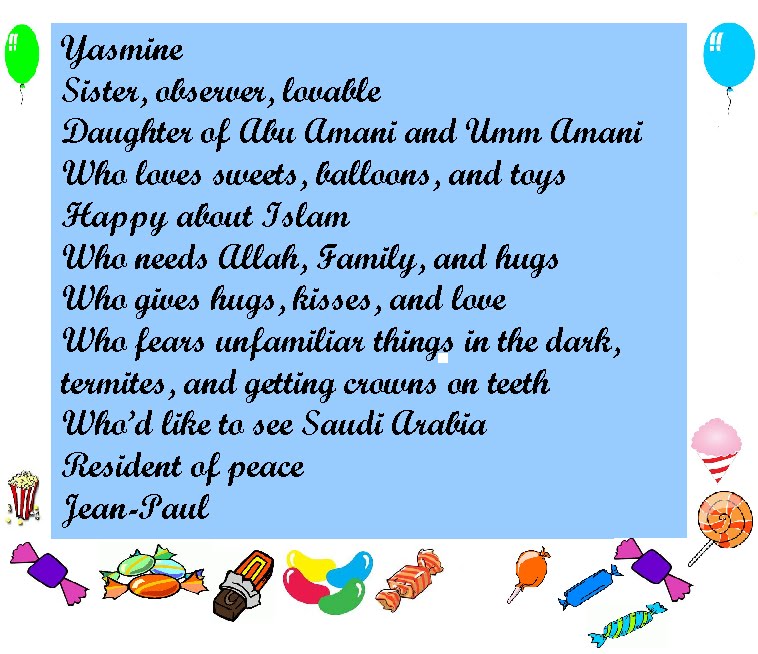
Pull out your construction paper, pencils, crayons and markers! It’s time for self-indulging! Time to make an “All About Me” book. This project is fun, simple, yet invites deep inner thoughts for all ages. Each page can be a guide for discussing Islamic reminders such as duas or the proper adab for a Muslim. Some children find it difficult to express themselves in speech or writing. This project allows them the freedom to open-up visually. As an intro for your child’s “All About Me” book, have them write an autobiographical poem. An autobiographical poem is a poem that the author writes about himself. An autobiographical poem begins with your first name and ends with your last name. Follow the directions below for each line. When finish with poem be sure to decorate! Next have child create a “What makes me feel….” page for each emotion: happy, sad, frustrated, blessed, scared and silly. Following those pages, create a “My Family” page. And lastly, “Things I want to accomplish in life,” page. Just remember, this is “creative freedom” zone!

Available for Purchase


“Arabic Coloring & Activity Book” contains over 45 pages of Arabic vocabulary words. Each page is fun, simple, and exciting. This coloring and activity book encourages the child to learn as well as express their creative imagination.

Available For Purchase


“Tawheed Essential Learning for Children” bears almost nothing in common with other Islamic workbooks on the market. Carefully developed around “Teaching Children Tawheed” by Shaykhul-Islam Muhammad bin ‘Abudl-Wahhaab, this workbook targets how well the child understands basic principles of tawheed, through real life applications; a challenging skill for even adults to master. The child is asked to construct a Venn Diagram, write a friendly letter, as well as write poems. All of which is based upon their understanding of tawheed and its principles. These conceptual applications encourage the child to put on their “thinking cap” and clearly communicate what they were taught regarding tawheed in writing.

“Tawheed Essential Learning for Children” is a 24 page children’s workbook that’s simple in textual content, yet provokes thought and understanding for the child along with the parent about tawheed. Insha Allah, it can not be completed in a day or two; or even a week. With proper parental guidance, insha Allah, parents will be able to better gauge their child’s strengths and weakness of tawheed.

Activities for Children


As salaamu alaikum,
whether you are home schooling or not, finding constructive activities for your child can be tough. Masha Allah, the internet has opened avenues. But it can also become overwhelming. Insha Allah, you will start seeing activities posted for you and your child to do together.

Children enjoy seeing their masterpieces in places where not only they can see but others as well. So, feel free to upload your child's work at sales@pinehillpubs.com to share with children on our blog and upcoming website.